What the Road Out Front Costs in Jupiter Farms
In August, the engineer for the South Indian River Water Control District gave its board a final price for paving one stretch of 129th Place North, between Sandy Run and 150th Court North. The road is 2,689 feet long and has 14 lots. The cost came to $659,000, which covered construction, legal, survey, engineering and contingency. On a 10-year financing term at 4.85 percent, each lot's estimated assessment was $6,443 a year, according to the District's August 20, 2026 meeting minutes. By the October staff report, the petitioner had decided not to go to a referendum.
That one petition sums up how roads work in Jupiter Farms. A shellrock street and a paved street are different products with different yearly costs, and the cost of turning one into the other is high for every lot on the street. If you are comparing Jupiter Farms with other parts of north Palm Beach County, evaluate the road with the same care as the acreage, the barn and the house.
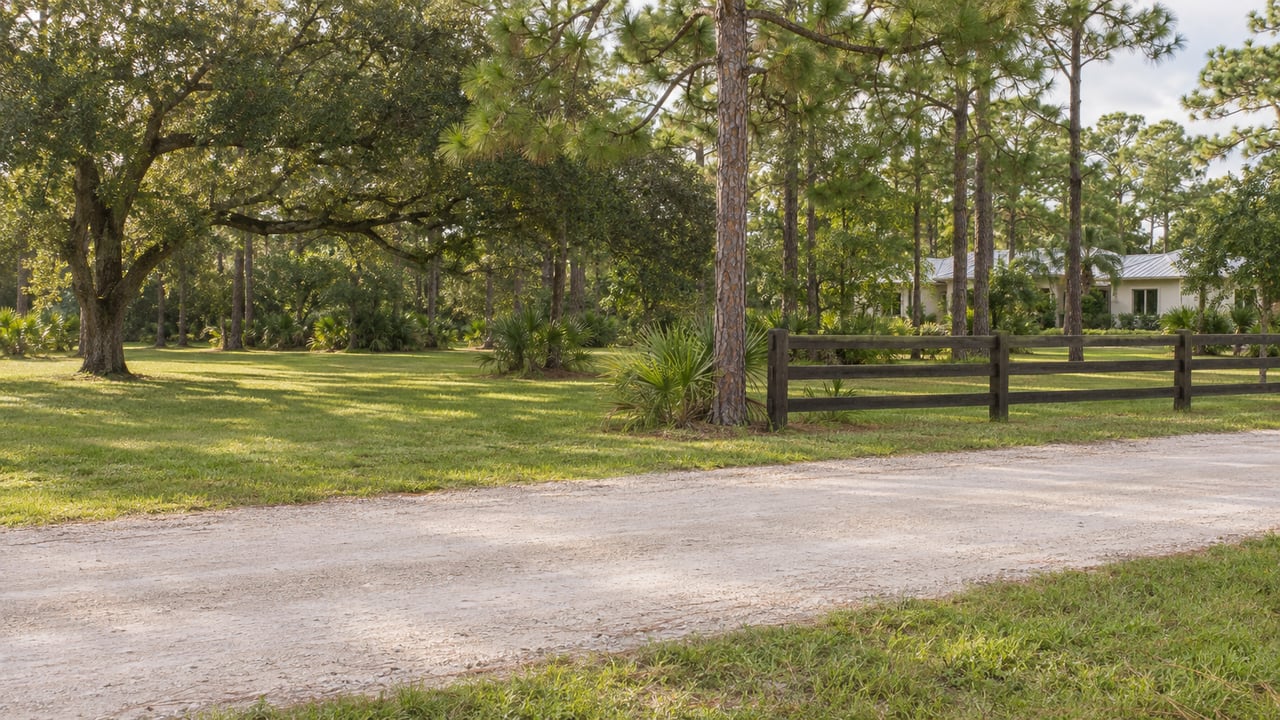
The South Indian River Water Control District is a special district with its office at 15600 Jupiter Farms Road. It handles drainage, canals and roads. The District describes most of its roads as "dirt" or unsurfaced roads built on shellrock or limerock base. Crews maintain them by grading and adding aggregate as needed. Its service request page says dirt roads are typically graded weekly. Grading can pause when conditions are too wet or too dry for the work to hold.
The District's April 2026 cost study counted 92 miles of unpaved road across its two communities. Sixty-three of those miles are in Jupiter Farms and 29 are in Palm Beach Country Estates. Another 97 miles across the District are already paved. Some roads are the county's to maintain instead, and Jupiter Farms Road is one of them. For the county's June 2, 2026 agenda, staff recommended $232,466.09 for design studies and construction plans on the stretch from Canal 7 to Canal 6, which includes a dirt link of about 250 feet.
For fiscal year 2026-27, the District's August 2026 newsletter put the District assessment on a typical 1.25-acre Jupiter Farms parcel at $686, up $151 from $535. That figure covers water control maintenance, road maintenance and equipment replacement, and the District said most of the increase came from road maintenance. The board adopted the budget at its August 20 hearing. These figures are general information and not legal, tax or financial advice, so confirm the charges on any specific parcel with the tax collector, the District or your own advisor.
Much of that increase goes onto the dirt roads themselves. This year the District is doubling the shellrock aggregate it places on unpaved roads. It is also rolling out a GIS-based Road Improvement Plan to organize maintenance and map what the roads will need over the next five years. For a buyer, that means the shellrock road in a listing photo should be in better shape over the coming year, and the higher assessment is paying for it.
At its April 16 meeting, the board heard the most detailed paving cost study it had seen in years. Chief Financial Officer Ryan Grigg compared 60 years of grading costs with 60 years of paving and resurfacing. He assumed resurfacing every 15 years, 5 percent interest and 30-year bonds. Supervisor Susan Kennedy said landowners had been asking for that information for more than 20 years. Using the District's average of about 48 parcels per mile of road, the study gave these figures, as recorded in the April 16, 2026 minutes:
| Estimate used | Initial paving cost per mile | Added yearly assessment per parcel, first 15 years | After first resurfacing |
|---|---|---|---|
| Wynn & Sons quote | $751,410 | $1,013 | $1,810 |
| AECOM estimate | $1,475,000 | $1,988 | $2,786 |
Wynn & Sons also quoted resurfacing at $379,800 per mile. On the AECOM estimate, paving every remaining unpaved mile in Jupiter Farms would cost about $93 million. Grading all 92 unpaved miles in the District currently costs $278,164 a year. As of March 31, 2026, the District's road renewal and replacement reserve was $820,853. Grigg said that covers about two miles of resurfacing without financing.
Compare the table with 129th Place North and the gap is easy to explain. That street has 14 lots on about half a mile of road, roughly 27 lots per mile, compared with the District's average of 48. Its $659,000 price works out to about $1.29 million per mile, closer to AECOM's figure than to the Wynn & Sons quote. The financing ran 10 years where the study assumed 30. Each of those three factors raised the cost per lot, and all three are typical of Jupiter Farms, where 1.25-acre parcels are common and fewer neighbors share each mile of road. On these streets, the large lots buyers come for also make each lot's share of paving larger.
The board did not agree on what the study meant. Supervisor John Meyer said paving "is very costly and is not just a one-time cost." He also told the board that in the last set of road referenda, none had more than half of the affected parcels in favor of paving. Supervisor Bob Berman questioned the 15-year resurfacing assumption and argued that landowners, not board members, should decide. Kennedy said owners on unpaved roads may be subsidizing paved ones, and she asked staff to look into separating the two costs. One Jupiter Farms landowner described the paving push as "turning a rural system into an urban one."
The record from this year all points the same way. The recent referenda Meyer described fell short of majority support. The one Jupiter Farms petition priced this year stopped before a vote. The District's reserve covers about two miles of resurfacing. A buyer touring a shellrock street in Jupiter Farms is best off judging it as a shellrock street. A buyer on a paved street is choosing a road that will need resurfacing at some point, and the April study's resurfacing figures show what that costs. The two kinds of street spread their costs over time in different ways, and the large lots make each owner's share bigger either way.
The rain the week before Thanksgiving showed what these roads are like after a storm. A flood watch ran for Palm Beach County from November 17 to November 20. The District recorded 1.66 inches of rain at its main office on November 18. Its November 19 update said Jupiter Farms road maintenance was postponed until normal operations could safely resume. Once grading resumes, shellrock streets go back to their weekly schedule. Buyers who tour in the days after a heavy rain will see the roads in their roughest shape, and that is worth seeing at least once before you make an offer.
Our earlier guide to acreage and outdoor living in Jupiter Farms covers the land side of this decision. For the road side, send us the Jupiter Farms addresses on your shortlist and Lighthouse Realty Group will drive each street with you, shellrock and paved, before you choose which one to write an offer on. Schedule a Free Consultation.
Get assistance in determining the current property value, crafting a competitive offer, writing and negotiating a contract, and much more. Contact us today.