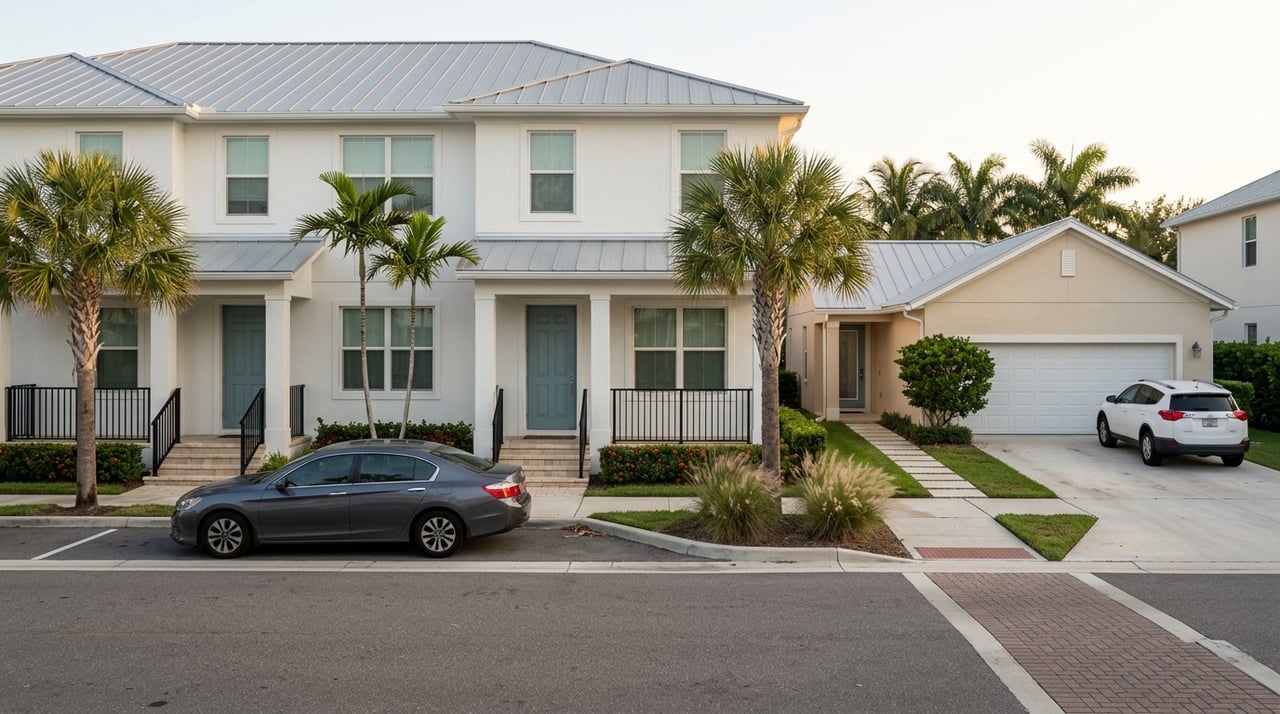
Townhome Vs Single-Family Living In Abacoa
If you are trying to choose between a townhome and a single-family home in Abacoa, the answer is rarely as simple as “more space” versus “less maintenance.” Abacoa is a master-planned community with a wide mix of village layouts, housing types, and amenity packages, so your day-to-day lifestyle can vary a lot from one neighborhood to the next. The good news is that once you understand how Abacoa is built, the decision becomes much clearer. Let’s dive in.
Abacoa spans about 2,055 acres and was designed around Traditional Neighborhood Development principles. That shows up in the details you notice right away, including front porches, alley-access garages, central greens, and a layout that encourages walking and biking.
The community also includes 20 residential neighborhoods, more than 20 commercial districts, two colleges, two science campuses, two public schools, a spring training stadium, a public golf course, a hotel, a shopping plaza, a Workplace District, and a Main Street-style Town Center. In practical terms, that means your housing choice is tied closely to how you want to live each day.
In many communities, townhomes and single-family homes are separated into distinct areas. In Abacoa, that is not always the case. Several villages include both product types, so your decision often comes down to a specific neighborhood rather than a broad community-wide rule.
Official neighborhood pages show mixed housing in places like Canterbury Place, New Haven, Mallory Creek, Cambridge, Martinique, The Island, and Windsor Park. That means you may find a townhome and a detached home in the same general setting, but with different ownership responsibilities, layouts, and outdoor space.
Townhome living in Abacoa usually means attached or terrace-style homes, smaller private outdoor areas, and more shared green space. For many buyers, that tradeoff feels worth it if the location is convenient and the amenities are strong.
Valencia is described as a boutique-style townhome community with tree-lined streets and maintained green spaces. San Palermo is a smaller Mediterranean-style townhome community with 34 residences, each around 1,867 square feet, with three to four bedrooms, detached two-car garages, and private courtyard-style patios.
Somerset adds another version of townhome living with two- and three-story terrace homes and a resort-style amenity setup. If you like the idea of a more compact footprint with neighborhood features built into the association, this style can be a strong fit.
Single-family living in Abacoa usually offers a more detached residential feel, but it still often comes with a strong HOA framework. That is an important distinction because detached does not always mean less structure or fewer community rules.
New Haven includes 405 single-family residences and 100 townhomes across two parcels. Mallory Creek has 267 single-family homes and 314 townhomes, while The Island at Abacoa includes 134 single-family homes and 42 townhomes around the Abacoa Golf Course. Cambridge also mixes 77 single-family homes with 132 townhomes.
If your priority is a broader range of home sizes, more separation from neighbors, or a more traditional detached-home setup, these villages may deserve a closer look. Windsor Park, for example, offers homes and townhomes ranging from 1,499 to 3,768 square feet across 16 layouts.
For many buyers in Abacoa, the real choice is not just townhome versus single-family. It is walk-to-town living versus a more residential enclave feel.
Several villages are especially clear about their walkable connection to Downtown Abacoa. Antigua at Town Center says shops and restaurants are a short walk up Main Street. Charleston Court highlights a short walk to Downtown Abacoa and Roger Dean Stadium, while Osceola Woods notes easy walking distance to Abacoa Plaza and Downtown Abacoa.
Canterbury Place says residents can easily walk or bike to restaurants and shops throughout Abacoa. Valencia also emphasizes an easy, walkable lifestyle close to parks, dining, entertainment, and other neighborhood destinations.
Other villages are still part of the Abacoa experience, but the official descriptions focus less on a direct walk-to-downtown setup. The Island at Abacoa is framed more as a golf-course community, while Mallory Creek highlights tree-lined streets, sidewalks, and proximity to Town Center. New Haven emphasizes its layout, pools, clubhouses, and playgrounds.
Abacoa has a master-level Abacoa Property Owners’ Assembly that manages day-to-day affairs at the assembly level. Neighborhood pages also note that an Abacoa POA estoppel is required for sales, which is a useful reminder that the closing process may involve both the village HOA and the master association.
This matters because product type does not always predict how much structure comes with ownership. Some townhome-oriented villages include extensive shared amenities, while some single-family-heavy neighborhoods also offer robust amenity packages.
Canterbury Place includes a heated pool, clubhouse with a grand room, fitness center, and aerobics studio. Somerset offers a heated swimming pool, fitness center, playground, library, business center, putting green, picnic area, and volleyball court.
Single-family-heavy villages can also offer substantial shared facilities. New Haven has two resident clubhouses, two year-round pools, and playgrounds. The Island has a clubhouse, pool, and playground, while Cambridge includes a clubhouse, pool, playground, and walking trails. Windsor Park features a clubhouse, fitness center, billiards room, fire pit gathering area, and a heated resort-style pool.
One of the most overlooked parts of buying in Abacoa is parking. Because the community design often includes alley-access garages and organized streetscapes, village rules may place more emphasis on garage use than buyers first expect.
The Island at Abacoa states that certain vehicles, including boats, campers, trailers, and some other vehicle types, are not allowed on common elements and must be parked inside the garage overnight. Mallory Creek’s FAQ also lists street parking and parking pickup trucks outside the garage overnight as common violations.
If you own multiple vehicles or need flexible storage, this is worth reviewing before you buy. In both townhome and single-family sections of Abacoa, your garage and driveway setup can affect daily convenience more than the home type alone.
The best choice depends on how you want your life in Abacoa to feel. If you picture walking to dinner, spending less time on private outdoor upkeep, and leaning into shared amenities, a townhome or terrace-style option in a more downtown-oriented village may be the better match.
If you want a more detached home feel, a broader range of sizes, or a neighborhood that feels a bit more tucked into the residential side of Abacoa, a single-family option may make more sense. Just remember that detached living here can still come with active HOA rules, shared facilities, and parking standards.
A simple way to compare your options is to ask these questions:
In Abacoa, townhome versus single-family living is really a lifestyle decision shaped by the village you choose. The strongest walk-to-town options tend to include Antigua at Town Center, Charleston Court, Osceola Woods, Canterbury Place, and Valencia. Buyers looking for a more detached feel and a broader range of home styles often focus on New Haven, Mallory Creek, The Island, Cambridge, and Windsor Park.
The key is to compare not just the home, but also the setting, parking setup, amenity package, and HOA structure. If you want help narrowing down the right Abacoa village for your goals, Kevin Keogh, Lighthouse Realty Group, Inc can help you evaluate the tradeoffs and find the best fit.

Get assistance in determining the current property value, crafting a competitive offer, writing and negotiating a contract, and much more. Contact us today.