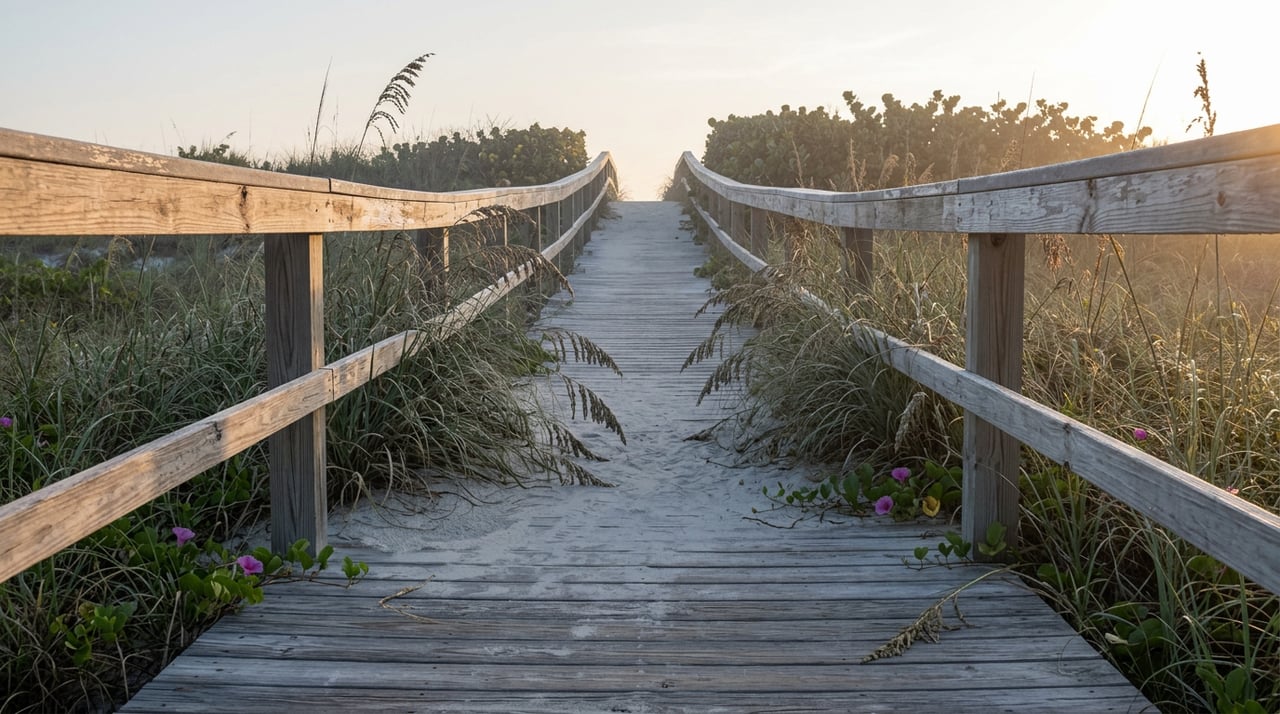
The Busiest Stretch of Sand in Palm Beach County Is Barely a Mile Long
Walk the beach at Jupiter Inlet Colony some evening this week and you'll notice more staked-off sections than you remember from past summers. More orange tape, more wooden markers pushed into the dune, more of that particular rectangle of roped-off sand that means a nest is incubating underneath. It is not your imagination. This town's beach is doing more work this season than almost anywhere else in the county, and the numbers behind that work say something residents here have not fully clocked.
Jupiter Inlet Colony's public beach runs about 0.9 miles. In 2025, researchers recorded 2,558 sea turtle nests on that stretch alone, according to the town's own sea turtle protection page. That single fact is the whole story in miniature. Loggerhead Marinelife Center patrols the same general corridor south to John D. MacArthur Beach State Park, a stretch LMC's own materials describe as 8.5 miles and the town describes as 9.5 miles. Either way, Jupiter Inlet Colony's beach is roughly a tenth of that corridor's length. Across the full corridor, LMC's research team documented 20,871 nests in 2025. Jupiter Inlet Colony's 2,558 nests amount to close to an eighth of that total, meaning a tenth of the beach carried an eighth of the season's load.
That is the claim worth sitting with before anything else here: this is not a town that happens to have turtles nesting on it. According to the town's own records, it is the single densest nesting habitat in Palm Beach County, inside a county that Loggerhead Marinelife Center already describes as the Western Hemisphere's most heavily nested loggerhead habitat.
On February 11, 2026, LMC documented the earliest sea turtle nest its own research team has ever recorded, a milestone the center attributes to warming ocean temperatures, according to its February release. That is not the same as the earliest nest Florida has ever seen statewide. That mark still belongs to a nest laid February 4, 2025, somewhere else along the coast. But for the specific stretch that starts at Jupiter Inlet Colony's town line, this year's first nest arrived before most residents had settled into spring plans.
Official nesting season runs March 1 through October 31. Today, in early August, the beach is past its May-through-July peak and moving into the back stretch of the calendar, though the work is far from finished. Average incubation runs about 60 days, per Jupiter's own FAQ on sea turtle protection. That means nests laid in the season's final weeks in October will still be hatching into December, well past the date the calendar officially calls the season closed.
Not every nest on this beach is anonymous. Researchers track individual turtles across a season, and one loggerhead the town's records identify as Kylie laid her fifth and final nest of the 2025 season on Jupiter Inlet Colony's beach. She was logged as a neophyte, meaning that season was the first time researchers had ever encountered her. A single female loggerhead can lay several clutches in one season, each one a separate crawl up the same beach, each one marked and monitored by the same research team that patrols from this town southward.
It is a small detail, but it reframes the staked-off sections differently. Those are not generic protected zones. Some of them are specific animals, tracked individually, returning to the same nine-tenths of a mile more than once in a single year.
This year, the voluntary Sea Turtle Protection Zone that asks boaters to slow down and watch for surfacing turtles now covers Palm Beach County's entire 45-mile coastline, an expansion LMC announced alongside its February nest report. The zone runs one mile offshore, March through October, from Jupiter Inlet to Boca Raton Inlet.
Most of that 45 miles is open shoreline. Jupiter Inlet Colony sits at a chokepoint instead, the mouth of the inlet itself, where every boat moving between the Intracoastal Waterway and the open Atlantic has to pass through a narrow channel rather than a wide stretch of open water. A protection zone that asks for slower travel and closer attention matters differently at a funnel point than it does along an unbroken beach, simply because there is more marine traffic packed into less water at exactly this spot.
Palm Beach County's Unified Land Development Code, Article 14.A, regulates lighting and construction along this beach, including on residential property, and the rule is not limited to new construction. According to the town's own page, replacing or installing any light source visible from the beach within Jupiter Inlet Colony's protection zone requires a permit from Palm Beach County Environmental Resource Management first. A porch fixture that burned out over the summer, an exterior sconce swapped during a renovation, a new dock light installed on a seawall facing the water, all of it falls under the same permit requirement, because artificial light visible from the sand can disorient nesting females and hatchlings trying to find their way to the water.
Residents who have lived here through several seasons may already know this. Anyone planning fall exterior work for the first time this year should build the permit step into the timeline before ordering fixtures, not after.
None of this is happening on a static backdrop. The town's own alerts page confirms dredging work at Jupiter Inlet was underway as of a January 21, 2026 update, posted the same month the town also held an interactive workshop on its resilience action plan. Both items landed on the town's civic alerts feed before this year's nesting season officially opened on March 1, which suggests a town timing its channel work and its long-term planning conversations around the same stretch of sand that would soon carry the season's heaviest nesting load.
The overlap says something about how this town treats its own coastline. The beach that quietly out-produces its neighbors on nests per mile is also the beach where the town spent this past winter managing channel depth and long-term resilience planning. Neither project happens without consequence for the other.
Jupiter Inlet Colony's residents already know the shape of a South Florida summer. What the numbers add this year is a clearer sense of scale: a town that covers a fraction of the county's protected coastline is quietly carrying more of its nesting load than that fraction would suggest, at the same time its inlet handles concentrated boat traffic and active dredging work most of the county's open shoreline never has to think about.
If you're weighing a move to this stretch of coastline, or already live here and have questions about how coastal regulations intersect with a property you own or are considering, Kevin Keogh and the team at Lighthouse Realty Group know this beach and this town well. Schedule a free consultation to talk through what a season like this one actually means for a home on Jupiter Inlet Colony's sand.
This article is general information, not legal, tax or financial advice. Consult a qualified professional about your situation.


Get assistance in determining the current property value, crafting a competitive offer, writing and negotiating a contract, and much more. Contact us today.