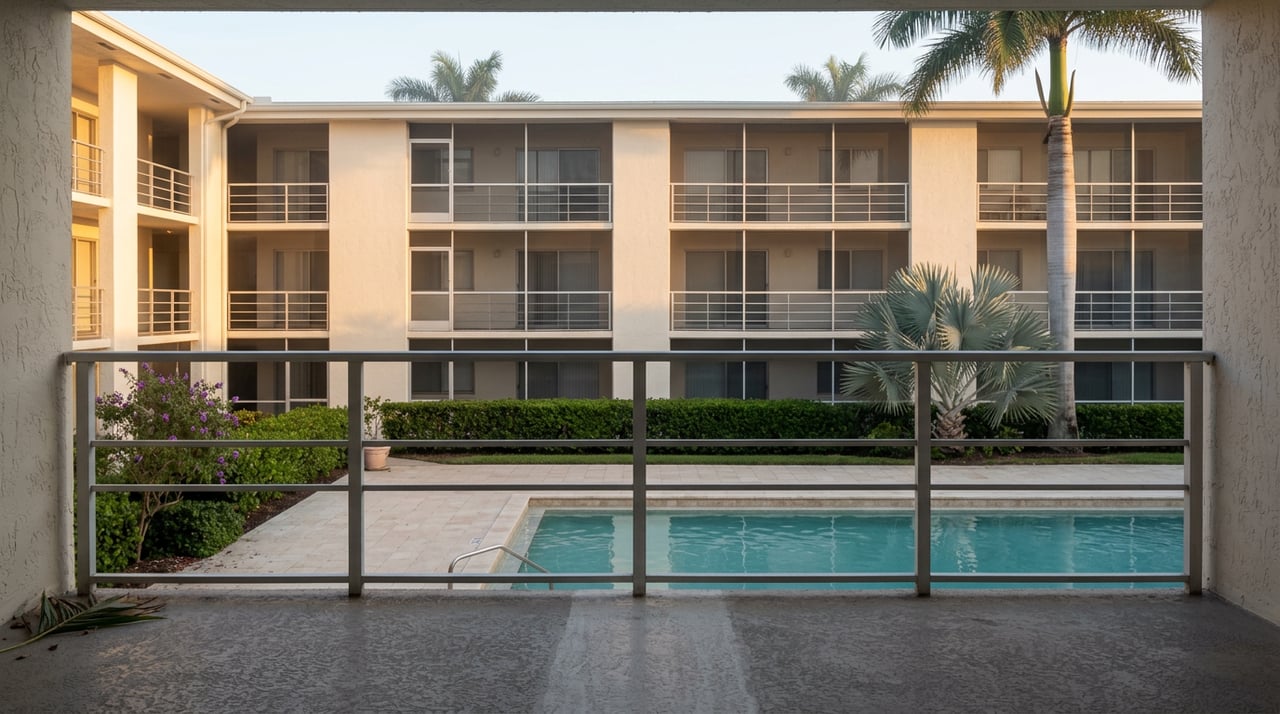
The Bluffs Has Two Kinds of Real Estate Now, and Florida's New Condo Law Just Drew the Line
Walk two properties in The Bluffs on the same afternoon and you'll notice something before you ever get to the kitchen. At a single-family home in The Ridge at the Bluffs, the paperwork folder is thin: a copy of the HOA covenants, a fee schedule, maybe a note about the pickleball court reservation system. At a condo in Marina at the Bluffs, that same folder is thick with engineering reports, a ten-year funding schedule, and a summary of a structural inspection performed by a licensed professional engineer.
That difference used to be a matter of degree. As of this year, it's a matter of law. Florida's post-Surfside reforms, most recently tightened by House Bill 913, took full effect for the 2026 budget cycle, and they apply with real teeth to condominium buildings while leaving traditional single-family HOAs almost untouched. The Bluffs, a single 300-plus-acre community built by DiVosta between 1984 and 1986, now contains both kinds of properties under one entrance sign. Buyers comparing a house to a condo here aren't just comparing square footage and view. They're comparing two different regulatory universes.
The Bluffs was built as one master-planned community, but it was never built as one type of ownership. The Ridge at the Bluffs is a homeowners association of 618 single-family homes governed under Florida Statute Chapter 720. Marina at the Bluffs is a 660-unit condominium spread across 22 four- and five-story buildings on the Intracoastal, governed under Chapter 718. Bluffs Ocean South, a gated oceanfront community of 198 units across seven four- and five-story buildings, falls under the same chapter.
That statutory distinction determines almost everything that happened to Florida real estate law over the past four years.
Single-family HOA (Chapter 720) | Condo association (Chapter 718) | |
|---|---|---|
Structural Integrity Reserve Study required | No | Yes, for buildings 3+ habitable stories |
Milestone inspection required | No | Yes, generally at 30 years post-certificate of occupancy, then every 10 years |
Reserve funding can be waived by owner vote | Yes, subject to normal HOA rules | No, not for the eight structural components identified in a SIRS, effective with 2026 budgets |
Governing documents and reserve studies must be posted online | No specific mandate | Yes, for associations with 25 or more units, effective January 1, 2026 |
Buyer's legal right to review financial and inspection records before being bound to contract | Standard HOA disclosure applies | Enhanced 7-day review window under 2026 reforms |
A house in The Ridge at the Bluffs can still face a special assessment if the pool needs resurfacing or a hurricane damages the clubhouse roof, and its board can still choose to underfund reserves the way Florida HOAs always have. But no state law forces that association to hire an engineer, fund a specific dollar amount toward structural components, or publish its books online. A condo one street over doesn't have that option anymore.
The reason this shows up so clearly in The Bluffs right now, rather than being an abstract legal footnote, comes down to arithmetic. Milestone inspections are generally required 30 years after a building's certificate of occupancy, then every 10 years after that. Marina at the Bluffs and Bluffs Ocean South were completed in the mid-1980s. Run the clock forward and their first mandatory milestone inspection would have landed around 2014 to 2016, with the next required cycle arriving right around now.
That timing collided with a separate deadline. Every condo association with buildings three stories or higher, regardless of age, had to complete its first Structural Integrity Reserve Study by December 31, 2025. Starting with the 2026 budget, full funding of the eight structural categories that study identifies became mandatory, with no owner vote available to waive it. Florida set the base threshold for one of those categories, the catch-all for any other structural item over a set dollar amount, at $25,675 for 2026, adjusted annually for inflation.
In plain terms: a Bluffs condo board that has been putting off a real conversation about roofs, waterproofing, or plumbing no longer has the legal option to keep putting it off. A board at The Ridge at the Bluffs facing the same aging infrastructure still does, at least on paper.
Not every association waited for the law to force the issue. Current listing disclosures for units at Marina at the Bluffs describe a community-wide roof replacement completed in 2022, an elevator upgrade finished in 2024, a milestone inspection already satisfied, and reserves described as healthy with no special assessment currently pending. Whether that reflects a board that read the writing on the wall early or simply good timing, the practical result for a buyer is the same: the structural work that other Florida associations are scrambling to fund under legal pressure right now appears to already be largely behind this one.
That contrast matters because the alternative has played out publicly elsewhere in the state. Owners at The Cricket Club in North Miami faced special assessments as high as $134,000 per unit in 2024. At Mediterranean Village in Aventura, some owners were assessed up to $400,000. Those are not Bluffs numbers, and nothing in the research suggests anything close to that scale here. They're the reason the law changed, and they're the scenario every buyer of a 1980s-era condo building should be pricing in as a real, if unlikely, tail risk rather than a hypothetical.
Insurance carriers have started treating SIRS and milestone compliance the same way. Citizens Property Insurance will not issue or renew policies for condo buildings that haven't completed both, and private carriers are increasingly following that lead. A building's paperwork isn't just a disclosure formality anymore. It's underwriting.
If you're evaluating a condo in The Bluffs, Florida law now gives you more leverage to ask hard questions than it did even two years ago. Before you're bound to a purchase agreement, you're entitled to request:
None of this applies if you're buying a single-family home in The Ridge at the Bluffs. That's not a loophole. It's the legal reality of a Chapter 720 association, and it means your due diligence there looks more like traditional HOA homework: reading recent board minutes, asking about the age of shared infrastructure like roads and drainage, and understanding the association's own reserve philosophy, since nothing compels it to follow the condo playbook.
The instinct when comparing a condo at Marina at the Bluffs to a house at The Ridge at the Bluffs is to weigh water access against yard space, or monthly dues against property taxes. Those comparisons still matter. But the comparison that's changed in the last year is regulatory exposure, and it runs in a direction that surprises a lot of buyers who assume newer construction or higher price points mean lower risk.
A 1986 condo building with a completed SIRS, a satisfied milestone inspection, and documented recent capital work has, in a real sense, already absorbed the risk that the law was designed to force into the open. A single-family HOA home, exempt from all of it, carries a different kind of uncertainty: nothing requires its board to have done that homework at all, whether the underlying infrastructure needs it or not.
Neither position is automatically safer. They're just governed by different rules, and in a community where both exist side by side, knowing which rulebook applies to the specific address you're evaluating is no longer optional homework. It's the first question.
Does every condo in The Bluffs fall under the new SIRS and milestone requirements? Any residential building three or more habitable stories in height is covered, regardless of age. Both Marina at the Bluffs and Bluffs Ocean South meet that threshold. Buildings with fewer than three habitable stories are exempt.
Can a single-family HOA in The Bluffs ever be forced into a similar mandatory reserve schedule? Not under current Florida law. Chapter 720 associations remain outside the SIRS and milestone framework. Their boards retain the ability to waive or underfund reserves through a standard owner vote, the same as before the 2022 reforms.
If a Bluffs condo association can't produce a SIRS or milestone report, what does that mean for a buyer? It's worth treating as a serious flag rather than an administrative delay. Under the 2026 transparency rules, associations with 25 or more units are required to make these documents accessible, and lenders and insurers can now see compliance status directly through the state's reporting system.
Is a fully funded reserve study a guarantee against future assessments? No. It's a snapshot based on current cost estimates and inspection findings, and Florida's rules allow associations to update SIRS every ten years or sooner. What full funding does provide is a documented, legally required baseline that didn't exist for most of these buildings' histories.
If you're weighing a condo against a single-family home in The Bluffs, or trying to read a specific association's compliance paperwork before you write an offer, Lighthouse Realty Group works this corridor closely enough to know which questions actually change the outcome of a transaction here. Schedule a free consultation and we'll walk through the documents with you before you're bound to anything.

Get assistance in determining the current property value, crafting a competitive offer, writing and negotiating a contract, and much more. Contact us today.