Two Governments Are Investing in Shoreline Access Around Jupiter Inlet Colony
Walk either of the two brick paths that carry Jupiter Inlet Colony's roughly 236 homes down to the water this month and you will notice two different things happening at once. To the south, the beach itself is wider than it was last summer, built up with sand that a dredge pumped ashore in the spring. To the north, across the inlet at the lighthouse property, the sound of pile drivers and the sight of new timber staircases climbing the dune have become part of the view. Neither project has anything to do with the other. Both are changing the shoreline around the inlet the Colony has looked at for almost seventy years.
That is the thing worth understanding about this town right now. It has no traffic to speak of, no commercial strip, and by most measures no real public works department. What it has instead is a shoreline where two separate governments, one town-sized and one federal, undertook distinct projects in the same year: the town rebuilt access stairs, while the federal agency began a larger stabilization and recreation project across the inlet. The contrast between what each one spent tells you more about how this place actually runs than any listing description will.
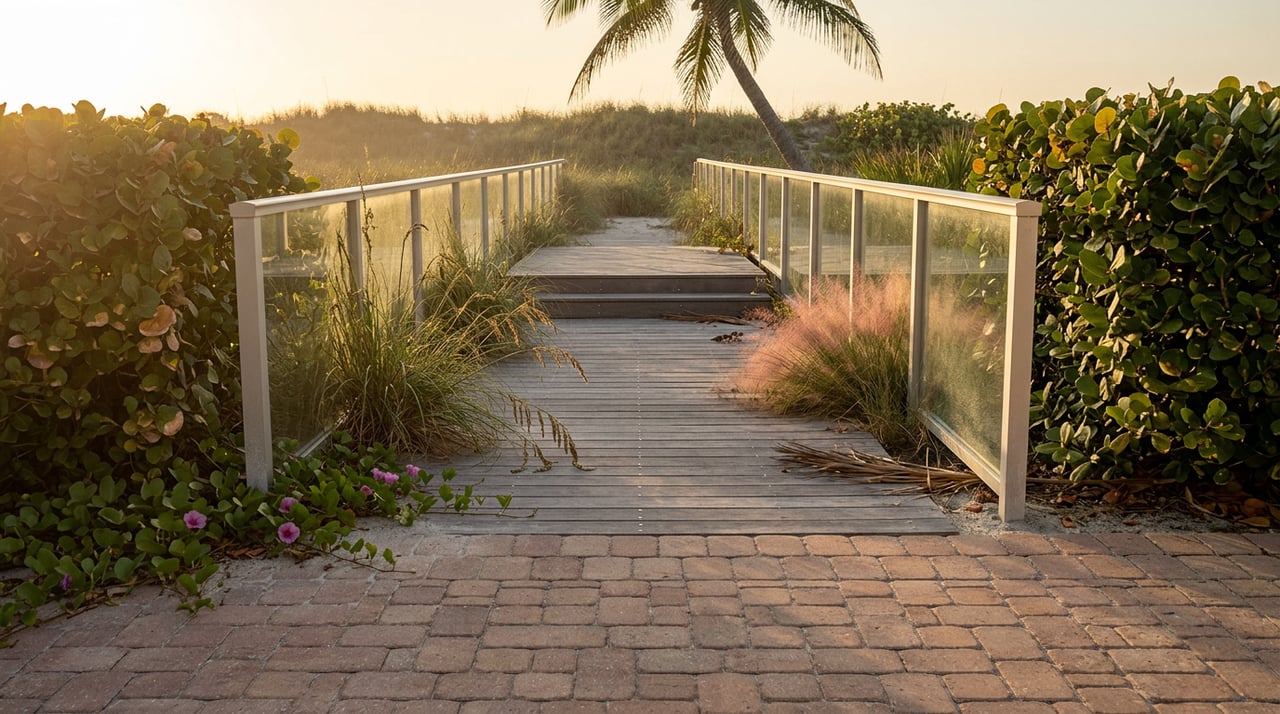
Jupiter Inlet Colony did not grow up around a Main Street. It grew up around a walk to the water. The land was assembled in 1958, when Charlie Martyn bought 86 acres at the southern tip of Jupiter Island from Jack Whitney for roughly $3,000 an acre and set about paving the roads, running water and electric lines, and platting a village. Early buyers included the golfer Tony Penna and the singer Perry Como, and by 1972 the community had grown to 192 homes. It has never had a school, never installed a gate, and never needed one. What it has always had is the beach, reached by two brick walkways lined with flowering plants that residents and the town's own landscaping crews have maintained for decades.
The town still runs itself the way a place that size can. There is an elected mayor, four commissioners, and a small police department housed at 50 Colony Road, right at the community's entrance. The town's civic calendar is not built around ribbon cuttings or council chambers packed with development hearings. It is built around the Beach Club. When the Colony's Garden Club marked its 50th anniversary, the celebration happened at the Beach Club, not at a hotel ballroom or a country club up the road. This year's Fourth of July followed the same pattern: a parade at 3 p.m., then a town celebration at the Beach Club running until 7, organized by volunteers coordinating with the town on routes and traffic control. In a town this size, the Beach Club is not an amenity tacked onto real estate listings. It is the closest thing the Colony has to a town square.
That civic weight shows up in how the town spends money, and this year it showed up in a specific dollar figure. At its February 2026 commission meeting, the town approved a $38,000 contract to construct new stairs at the North Walkway Access after learning that the contractor originally lined up for a seawall project could not take it on. The commission covered the cost from savings on an earlier observation deck project and from funds already budgeted for road work, and approved it unanimously. Thirty-eight thousand dollars is a rounding error against most municipal budgets. In Jupiter Inlet Colony, it was enough of a line item to require its own vote, its own funding source, and its own place on the agenda, because the walkover is not a side project here. It is the infrastructure.
A few hundred yards north, on the other side of the water, the federal government is running a version of the same project at a wildly different scale. The Jupiter Inlet Lighthouse Outstanding Natural Area, a 120-acre property managed by the Bureau of Land Management and the only unit of the National Conservation Lands system east of the Mississippi River, broke ground in March 2025 on a $16 million shoreline stabilization and resilient recreation project. The scope includes seven new staircases spanning the property, roughly 900 feet of boardwalk, and a series of breakwaters meant to protect the shoreline long term. According to the project's update posted in January 2026, crews were still installing the pilings for those staircases, with carpentry work on the steps and the boardwalk construction to follow after that. The project team has also been salvaging plants ahead of construction, relocating roughly 200 individual specimens to the Nature Conservancy's Blowing Rocks Preserve so they can eventually be returned to the site.
Put the two numbers next to each other. The Colony spent $38,000 to rebuild one staircase its own residents use every day. The BLM is spending $16 million to rebuild seven staircases and a boardwalk on the property directly across the water. Neither project is bigger or smaller than it needs to be. Both are proof that around Jupiter Inlet, the walk to the water is worth fighting for, whether the entity doing the fighting is a five-member town commission or a federal land agency.
The third piece of this year's shoreline story finished before either of the staircase projects made much visible progress. The Jupiter Inlet District's 2026 Sand Trap Dredging and Beach Nourishment Project wrapped up on April 26, 2026, when the contractor completed dredging and placement work on the inlet's sand trap. The project was planned around an estimated 100,000 cubic yards of sand, pumped by pipeline and placed as beach fill on the stretch of shoreline south of the inlet, between the state's survey monuments R-13 and R-19. That fill is why the beach at the south end of the Colony reads wider this summer than it has in past years, and why the channel itself should run a little cleaner for boaters working their way through the inlet.
None of this shows up in a typical neighborhood overview, because none of it is really about real estate. It is about the fact that a town with no schools, no gates, and barely 236 homes has its biggest civic projects this year focused on shoreline access. The Colony spends its money on stairs. The federal government spends its money on stairs. The tide brings in new sand whether either government asks it to or not. For the people who already live here, that combination is the actual story of 2026: not a market update, but the ground shifting a little, on purpose, right under their feet.
For anyone who wants a closer look at how homes in this stretch of Jupiter Island handle water access, our guide to dock and lift basics for Jupiter Inlet Colony buyers walks through the practical side, and our Jupiter Inlet Colony neighborhood page has more on the area day to day.
If you are weighing a move to this stretch of the inlet, or just want a local read on what a project like this means for a specific address, Lighthouse Realty Group knows this corridor block by block. Schedule a Free Consultation with Kevin Keogh to talk through what is changing along the water this year.

Get assistance in determining the current property value, crafting a competitive offer, writing and negotiating a contract, and much more. Contact us today.